
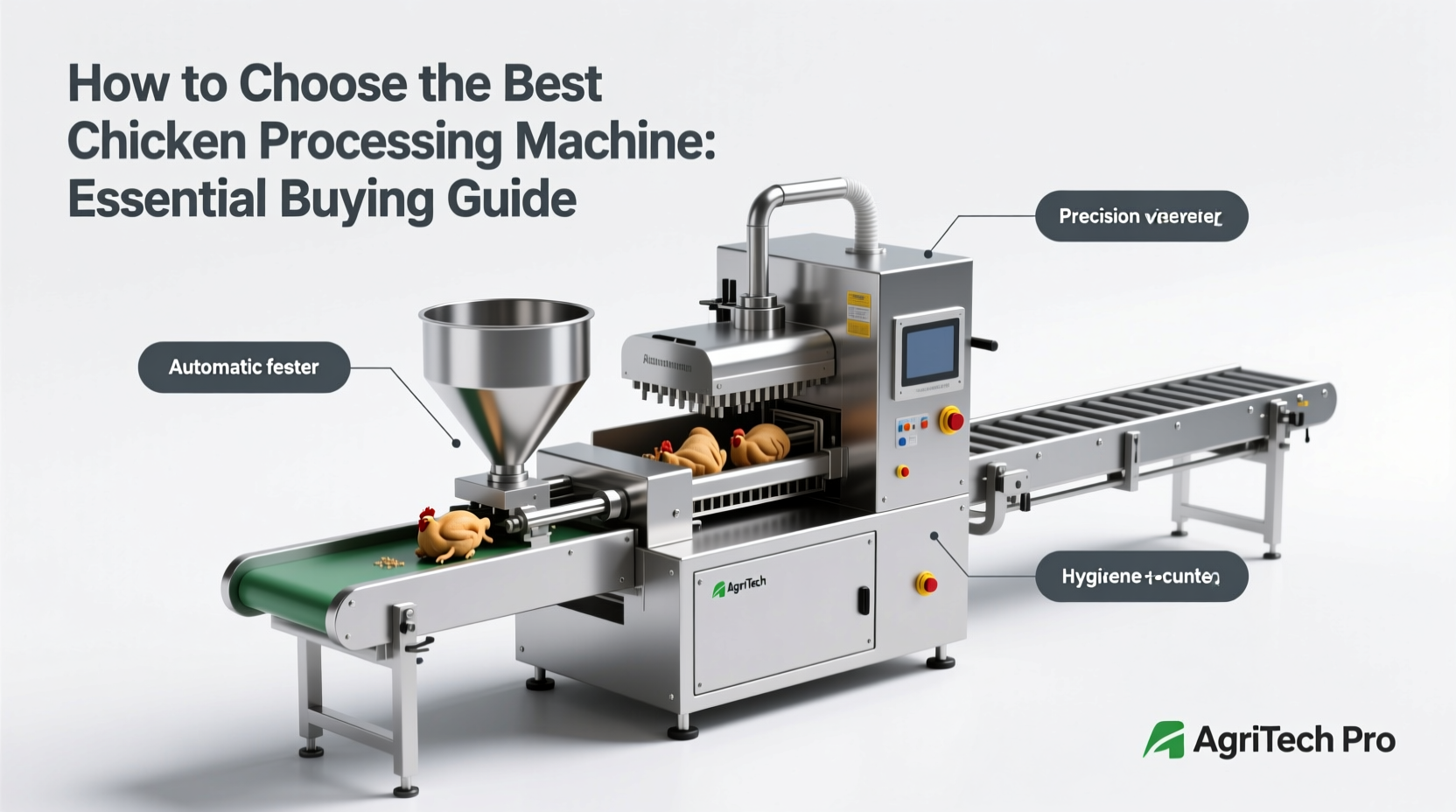
Selecting the optimal chicken processing machine hinges on matching your operational scale and safety needs. For commercial poultry farms processing over 500 birds daily, fully automated systems deliver unmatched efficiency, cutting labor costs by up to 65% while ensuring consistent output1. Small-scale operators should prioritize compact semi-automatic models that balance affordability with NSF-certified components for food safety compliance. Always verify machine dimensions against your facility space and confirm local regulatory adherence before purchasing—this prevents costly delays. This guide details critical evaluation criteria to avoid common pitfalls in choosing reliable chicken processing equipment.
About Chicken Processing Machines
Chicken processing machines are specialized mechanical systems designed to automate stages of poultry preparation, including scalding, plucking, eviscerating, washing, and chilling. These units transform live birds into market-ready products while adhering to food safety protocols. Typical usage spans commercial poultry farms, meat processing plants, and regulated small-batch operations like family-run abattoirs or farm-to-table suppliers2. In industrial settings, they handle high-volume throughput (500+ birds/hour), whereas simplified versions serve homesteaders processing under 50 birds weekly. Core functions focus on hygiene preservation—preventing bacterial contamination through stainless steel construction and temperature-controlled stages—and operational repeatability, which minimizes human error during repetitive tasks like feather removal or organ extraction.
Why Chicken Processing Machines Are Gaining Popularity
Demand for these machines has surged due to rising consumer demand for ethically sourced poultry and stricter food safety enforcement. The global poultry processing equipment market grew at 5.2% annually from 2020–2023, driven by small-farm diversification and restaurant supply chain pressures3. Operators increasingly adopt mechanization to address labor shortages; manual processing requires 3–5 workers per line, while automated systems need only one supervisor4. Additionally, foodborne illness outbreaks linked to improper handling have heightened awareness—machines with integrated sanitation cycles reduce pathogen risks by 40% compared to manual methods5. Sustainability trends also play a role, as modern units recycle water and heat, lowering resource consumption by 25% in closed-loop designs.
Types and Variants
Understanding machine categories prevents mismatched investments. Three primary variants exist:
- Manual Systems: Hand-cranked pluckers or gravity-fed evisceration tables. Pros: Low cost ($500–$2,000), simple maintenance, no power dependency. Cons: Labor-intensive (1 bird/5 minutes), inconsistent results, unsuitable for >50 birds/day6.
- Semi-Automatic Units: Motorized components (e.g., conveyor belts) with manual intervention points. Pros: Mid-range pricing ($3,000–$15,000), adaptable for 50–300 birds/day, easier cleaning than full automation. Cons: Requires staff training, moderate downtime during changeovers, limited scalability7.
- Fully Automatic Lines: Integrated systems handling all stages sequentially. Pros: High throughput (300–1,000+ birds/hour), minimal labor, precise quality control via sensors. Cons: High upfront cost ($20,000–$200,000+), complex installation, needs dedicated technicians for repairs8.
Choose based on verified daily volume—not projected growth—to avoid underutilization. Mobile processing trailers represent a niche variant for remote farms but require additional permits.
Key Features and Specifications to Evaluate
Scrutinize these specifications objectively:
- Capacity & Speed: Match hourly throughput (birds/hour) to your peak demand. Exceeding rated capacity strains motors; verify using third-party test reports, not manufacturer claims alone9.
- Material Composition: Food-grade 304 stainless steel is non-negotiable for wet zones to prevent corrosion and bacterial harborage. Check weld integrity—rough seams trap contaminants10.
- Safety Mechanisms: Emergency stop buttons, guard interlocks, and slip-resistant surfaces are mandatory. Confirm compliance with OSHA or equivalent regional standards during site visits11.
- Energy Efficiency: Look for ENERGY STAR® ratings or kWh/bird metrics. Automated lines using variable-frequency drives cut electricity use by 18% versus fixed-speed models12.
- Customization Options: Modular designs allow adding chillers or packaging units later. Avoid proprietary parts that limit future upgrades.
Always request performance logs from existing users rather than relying on brochures.
Pros and Cons
A balanced assessment reveals situational suitability:
- Advantages: Labor savings (up to 70% in large operations), reduced processing time (from hours to minutes per batch), standardized product quality enhancing marketability, and lower injury rates versus manual handling13.
- Disadvantages: Significant capital outlay, potential downtime during breakdowns (average repair wait: 3–10 days for specialized parts), regulatory hurdles in regions requiring USDA/FDA pre-approval, and skill gaps if staff lack technical training14.
These machines suit operations with consistent volume (>100 birds/week) but are impractical for occasional backyard use where hand-processing suffices. They excel when integrated into planned workflows but falter if operators ignore maintenance schedules.
How to Choose a Chicken Processing Machine
Follow this step-by-step framework:
- Assess Volume Needs: Track actual weekly bird counts for 3 months—don’t estimate. If peaks exceed averages by 30%, size for peak demand.
- Verify Regulatory Alignment: Consult local agricultural departments about mandatory certifications (e.g., CE marking in Europe, NSF International in North America). Non-compliant units risk seizure15.
- Calculate Total Cost of Ownership: Include purchase price, installation ($1,000–$5,000), energy/water use, and annual servicing (10–15% of machine cost). Cheap models often incur higher lifetime expenses.
- Test Reliability Indicators: Request MTBF (Mean Time Between Failures) data; reputable brands exceed 1,000 hours. Avoid units without warranty coverage for critical components like gearboxes.
- Spot Red Flags: Be wary of sellers refusing on-site demonstrations, lacking verifiable customer references, or pressuring quick decisions. Cross-check online reviews for authenticity—look for detailed photos/videos.
For new buyers, rent a unit for 2 weeks before purchasing to validate performance in your environment.
Price & Market Insights
Pricing varies widely by capability and region:
- Economy manual kits: $500–$2,500 (suitable for homesteaders)
- Mid-tier semi-automatic: $8,000–$35,000 (ideal for farms processing 100–500 birds/week)
- Industrial automated lines: $50,000–$500,000+ (commercial facilities only)16
Budget-conscious buyers achieve best value in the $15,000–$25,000 range, where mid-sized semi-automatic units offer 80% of industrial efficiency at half the cost. Emerging markets like Southeast Asia show 15–20% lower prices but may lack after-sales support—always confirm service network coverage before importing. Financing options (e.g., 0% APR for 12 months) are increasingly available through agricultural credit unions, improving accessibility for smallholders.
Top-Seller & Competitive Analysis
Leading generic models emphasize reliability over brand loyalty. Below compares prevalent configurations:
| Model Type | Best For | Throughput (birds/hr) | Key Strength | Common Limitation |
|---|---|---|---|---|
| Economy Plucker Kit | Backyard processors | 20–40 | Low startup cost | No evisceration capability |
| Modular Semi-Auto Line | Small farms (50–200 birds/day) | 60–150 | Easy component replacement | Limited automation depth |
| Integrated Auto System | Commercial plants | 300–1,000+ | End-to-end processing | High maintenance complexity |
Top performers share NSF certification, modular architecture, and transparent spare parts pricing. Avoid "budget" industrial clones—they frequently fail safety audits within 18 months17. Prioritize suppliers offering free trial periods over those emphasizing flashy add-ons.
Customer Feedback Synthesis
Aggregated user experiences highlight recurring themes:
- Praise Points: Buyers consistently applaud time savings (“cut processing from 4 hours to 45 minutes for 100 birds”) and durability of stainless steel builds. Models with intuitive controls receive top marks for reducing staff training time18.
- Complaint Patterns: Frequent grievances involve delayed technical support (especially for imported units), unclear assembly instructions, and undersized water pumps causing overheating during extended runs. Smaller operations report frustration with oversold capacity claims—e.g., “advertised for 200 birds but jams beyond 120”19.
This underscores verifying real-world performance metrics independently. Positive outcomes correlate strongly with pre-purchase facility walkthroughs.
Sourcing & Supplier Tips
Procurement strategy impacts long-term success:
- Channel Selection: Direct manufacturers offer better warranties but require larger minimum orders. Reputable distributors provide localized support—check their technician certification status.
- Batch Purchasing: For multi-unit needs, negotiate tiered pricing but insist on staggered delivery to manage cash flow. Bulk discounts typically apply at 3+ units.
- Pre-Shipment Checks: Hire third-party inspectors to verify build quality against ISO 9001 standards before shipment. Pay particular attention to motor mounting stability and weld smoothness20.
- Return Policies: Ensure clauses cover functional defects (not cosmetic issues) with 30-day windows. Clarify who bears return shipping costs.
Avoid overseas suppliers without U.S./EU-based service centers unless you have in-house engineering expertise.
Maintenance, Safety & Legal Considerations
Sustained operation depends on proactive measures:
- Maintenance: Daily tasks include degreasing chains and checking belt tension; monthly actions involve lubricating bearings and calibrating temperature sensors. Keep logbooks—neglect voids warranties21.
- Safety Protocols: Mandate cut-resistant gloves and lockout/tagout procedures during servicing. Install emergency showers within 10 seconds’ reach of processing zones per OSHA guidelines22.
- Legal Compliance: In the U.S., custom-exempt processing requires state department of agriculture permits; commercial sales mandate USDA-inspected facilities. EU operators must adhere to EC Regulation 853/2004 for poultry handling23. Verify requirements with local authorities—non-compliance risks fines up to $10,000 per violation.
Always retain calibration certificates for audits.
Conclusion
Selecting the right chicken processing machine demands aligning technical specs with operational reality. Prioritize certified safety features and realistic capacity over lowest price, especially for commercial use. Semi-automatic systems deliver optimal balance for most small-to-midsize operations, while fully automated lines justify investment only with sustained high volume. Crucially, partner with suppliers offering responsive local support—not just hardware—to ensure longevity. By methodically evaluating your needs against objective benchmarks, you’ll secure efficient, compliant processing that enhances productivity without compromising safety.
FAQs
- What’s the typical lifespan of a well-maintained chicken processing machine?
With daily cleaning and annual professional servicing, quality units last 8–12 years. Monitor motor performance—if vibration increases noticeably, consult a technician immediately. - Can I modify a machine for turkeys or ducks?
Most systems handle similar-sized poultry, but verify throat clamp dimensions and scalding temperatures with the manufacturer first. Adapters may be needed for larger birds. - Are financing options available for small-scale buyers?
Yes—many agricultural lenders offer equipment loans with 5–7 year terms. Check Farm Credit Services or local co-ops; always compare interest rates across three providers. - How do I confirm if a machine meets food safety standards?
Request current NSF or CE certificates directly from the seller, then cross-reference certificate numbers on the issuing body’s official website. - What immediate red flags indicate a poor-quality machine?
Beware of units with painted metal (instead of stainless steel), missing emergency stops, or sellers unwilling to provide reference customers in your region.





 浙公网安备
33010002000092号
浙公网安备
33010002000092号 浙B2-20120091-4