
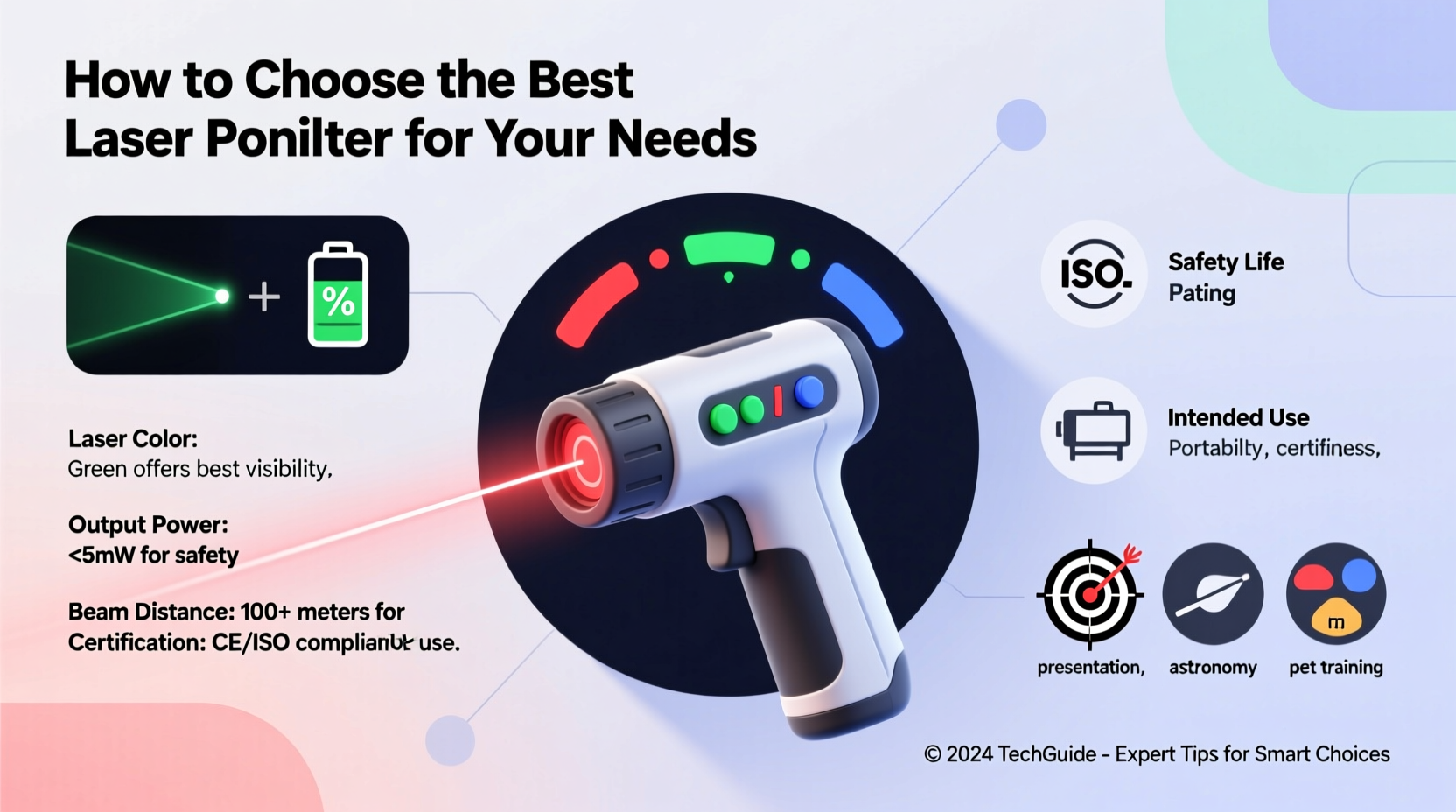
When choosing the best laser pointer for your needs, focus on intended use, output power (measured in milliwatts), beam visibility, safety features, and legal compliance. For classroom presentations, a 1–5mW green laser pointer with visible beam and keylock function is ideal 1. Outdoor astronomy enthusiasts often prefer higher-powered (up to 50mW) green lasers with longer range and star-pointing capability 2. Always verify FDA compliance and avoid overpowered or unregulated models that pose eye or flight hazards. Understanding how to choose a laser pointer based on brightness, color, durability, and safety prevents misuse and ensures value.
About Laser Pointers
A laser pointer is a small, handheld device that emits a narrow, coherent beam of light through stimulated emission. Most commonly powered by batteries, these devices project a bright spot onto surfaces for pointing, alignment, or visual demonstration. While typically associated with classroom lectures or business presentations, modern laser pointers are used across diverse fields including construction, astronomy, pet training, and scientific research 3.
The core components include a laser diode, optical lens, power source (usually AAA or button cells), and housing. The emitted beam’s color depends on the wavelength: red (~650nm), green (~532nm), blue (~450nm), and violet (~405nm) are most common. Green lasers appear brightest to the human eye due to peak sensitivity in daylight vision, making them more effective for long-distance pointing 4.
Why Laser Pointers Are Gaining Popularity
Laser pointers have evolved beyond simple presentation tools. Their compact size, affordability, and improved performance have expanded their appeal. Educators rely on them for engaging students during large lectures, while amateur astronomers use high-visibility green lasers to identify celestial objects during stargazing sessions 5.
In industrial settings, laser alignment tools assist in leveling floors, installing tiles, or aligning machinery. Pet owners use low-power red lasers for interactive play with cats and dogs, though concerns about psychological effects have prompted responsible usage guidelines 6.
Additionally, advancements in diode technology have made powerful, battery-efficient models accessible to consumers, fueling demand for multipurpose laser devices. However, increased accessibility has also led to misuse—such as aiming at aircraft—which underscores the importance of understanding what to look for in a laser pointer before purchasing.
Types and Variants of Laser Pointers
Different laser types serve distinct purposes. Choosing the right one depends on application, environment, and safety considerations.
Red Laser Pointers (630–670nm)
- Pros: Inexpensive, energy-efficient, widely available, safe at low power (<5mW).
- Cons: Less visible in bright rooms or outdoors; shorter effective range.
Ideal for short-range indoor use like office meetings or small classrooms. These are the original and most basic type, often found in budget-friendly models.
Green Laser Pointers (520–532nm)
- Pros: Up to 50x brighter than red at same power; excellent visibility even in ambient light; preferred for outdoor use.
- Cons: More expensive; sensitive to temperature; may require infrared filtering.
Popular among educators, tour guides, and astronomers. A green laser pointer with 5mW output can be seen clearly up to several hundred meters under clear conditions 7. Beware of cheap models that leak IR radiation due to poor design.
Blue Laser Pointers (445–465nm)
- Pros: High power available (up to 1000mW); striking visual effect; useful in fluorescence demonstrations.
- Cons: Expensive; significant eye hazard; often mislabeled as 'safe' despite being Class 4.
Used in specialized applications such as photography lighting effects or scientific experiments. Not recommended for general pointing tasks due to safety risks.
Violet/UV Laser Pointers (405nm)
- Pros: Can detect fluorescent materials; useful in forensics or currency verification.
- Cons: Very dim to human eye; potential skin and eye damage if overused.
These operate near ultraviolet spectrum and are primarily niche tools rather than presentation aids.
Key Features and Specifications to Evaluate
To make an informed decision when learning how to choose a laser pointer, consider the following technical and practical factors:
- Output Power (mW): Ranges from 1mW (safe for presentations) to over 1000mW (industrial/hazardous). The FDA limits consumer laser pointers to 5mW in the U.S. 8. Higher power increases brightness but also risk.
- Wavelength (nm): Determines color and visibility. Green (532nm) offers optimal balance of brightness and efficiency.
- Beam Visibility & Divergence: Measured in milliradians (mrad). Lower divergence means tighter beam over distance. Atmospheric scattering enhances green beam visibility at night.
- Battery Type & Life: AAA, AA, or rechargeable lithium-ion. Check runtime under continuous use mode.
- Build Quality: Aluminum alloy bodies offer better heat dissipation and durability compared to plastic housings.
- Safety Features: Look for key switches, safety interlocks, aperture shutters, and warning labels. Some models include beam delay or momentary-on buttons to prevent accidental activation.
- Compliance Labels: Must include FDA registration number (U.S.), CE mark (Europe), and proper class labeling (Class II, IIIa, etc.).
Pros and Cons of Using Laser Pointers
Advantages
- Enhances engagement during presentations.
- Enables precise targeting over long distances.
- Portable and easy to integrate into professional or recreational activities.
- Versatile across education, science, and industry.
Disadvantages
- Risk of eye injury if misused, especially with high-power units.
- Potential for distraction or misuse (e.g., pointing at vehicles or people).
- Legal restrictions vary by country; some regions ban public use of certain classes.
- Poor-quality models may fail prematurely or emit unsafe radiation levels.
Laser pointers are suitable when used responsibly in controlled environments. They are not appropriate for children without supervision or in settings where accidental exposure could occur.
How to Choose a Laser Pointer: Step-by-Step Guide
- Define Your Use Case: Presentation? Astronomy? Alignment? Each requires different specs.
- Select Wavelength: Green for maximum visibility, red for economy, blue/violet only for specialty uses.
- Check Power Rating: Stick to ≤5mW for general use. Avoid unverified claims like “50mW” sold as ‘pointer’—this exceeds legal limits 9.
- Verify Safety Compliance: Ensure it meets FDA (U.S.) or IEC 60825 standards. Check packaging for certification marks.
- Inspect Build and Controls: Metal body, secure cap, switch type (momentary vs. constant-on), and included safety lock.
- Avoid Red Flags: No model number, missing compliance info, exaggerated power claims, priced significantly below market average.
- Read Real User Reviews: Focus on comments about consistency, overheating, and actual beam performance.
- Buy From Reputable Retailers: Amazon, authorized distributors, or educational supply stores reduce counterfeit risk.
Price & Market Insights
Laser pointer prices vary widely based on quality, power, and brand reputation.
- Budget Tier ($5–$15): Basic red or green models; often lack proper filtering or accurate power ratings. Suitable only for occasional indoor use.
- Mid-Range ($15–$40): Reliable green lasers with metal casing, decent runtime, and verified 5mW output. Ideal for teachers and professionals.
- Premium ($40–$100+): High-build-quality pointers with precision optics, multiple modes (dot, line, pulse), and robust safety features. Commonly used in fieldwork or outdoor education.
Be cautious of ultra-cheap high-power lasers online—they are frequently non-compliant and potentially dangerous. True value lies in reliability, safety, and adherence to specifications, not raw power alone.
| Model Type | Avg. Price | Power Output | Best For | Safety Class |
|---|---|---|---|---|
| Red Diode (Plastic Body) | $6 | 1–3mW | Indoor Presentations | Class II |
| Green DPSS (Metal Body) | $25 | 5mW (verified) | Large Rooms, Outdoor Talks | Class IIIa |
| Blue High-Power (Rechargeable) | $70 | 1000mW | Specialty Projects Only | Class IV |
Customer Feedback Synthesis
Analysis of verified buyer reviews reveals consistent patterns:
Common Praises:
Users appreciate green lasers for their clarity and long-range visibility. Models with metal construction and secure battery compartments receive positive remarks for durability. Teachers highlight ease of use and student engagement during lessons.
Frequent Complaints:
Many negative reviews cite inaccurate power labeling—devices advertised as 5mW actually exceed limits or degrade quickly. Others report short battery life, loose caps, or sudden failure after weeks of use. Some buyers unknowingly purchased Class IV lasers, leading to safety concerns.
To mitigate these issues, always cross-check product descriptions with independent review sites and request specification sheets when buying in bulk.
Sourcing & Supplier Tips
For individual buyers, purchase from established platforms like Amazon, B&H Photo, or educational equipment suppliers. These vendors typically vet products for regulatory compliance.
For bulk orders (schools, conferences, corporate kits), contact certified distributors directly. Request proof of FDA listing or CE certification. Consider ordering samples first to test beam quality, switch feel, and labeling accuracy.
If reselling, ensure your supplier provides warranty support and return options. Avoid drop-shipping from unknown overseas warehouses, as many lack proper documentation and traceability.
Maintenance, Safety & Legal Considerations
Maintenance: Keep lenses clean with microfiber cloth. Replace batteries promptly to prevent leakage. Store in cool, dry place away from direct sunlight.
Safety: Never point at eyes, reflective surfaces, or moving vehicles. Use protective eyewear when working with Class 3B or 4 lasers. Keep out of reach of children.
Legal Notes: In the U.S., pointing a laser at an aircraft is a federal crime punishable by fines and imprisonment 10. Many countries restrict public possession of lasers above 1mW or require permits. Always check local laws before using high-power models outdoors.
Conclusion
Choosing the right laser pointer involves balancing purpose, safety, legality, and build quality. For most users, a compliant 5mW green laser pointer with metal housing and safety lock offers the best combination of visibility and responsibility. Avoid overpowered or uncertified models, especially those marketed with exaggerated claims. By understanding what to look for in a laser pointer—including accurate power rating, proper labeling, and reliable construction—you can make a smart, safe, and effective purchase that meets both functional and ethical standards.
FAQs
Q: What is the safest laser pointer for classroom use?
A: A Class II or Class IIIa green or red laser with ≤5mW output, safety key, and FDA compliance is safest for educational settings.
Q: Can I legally own a high-power laser pointer?
A: Laws vary by country. In the U.S., owning a laser >5mW is legal, but its use is heavily regulated—especially near airports or crowds.
Q: Why is my green laser dimmer than expected?
A: Poor-quality DPSS modules degrade over time. Temperature changes and lack of IR filtering can also reduce visible output.
Q: How far can a laser pointer go?
A: A 5mW green laser beam can travel over 1 km in clear air, but the visible dot diminishes with distance due to divergence and atmospheric scattering.
Q: Do laser pointers work in daylight?
A: Indoors, yes—especially green models. Outdoors in direct sun, even powerful lasers become hard to see beyond short ranges.





 浙公网安备
33010002000092号
浙公网安备
33010002000092号 浙B2-20120091-4