
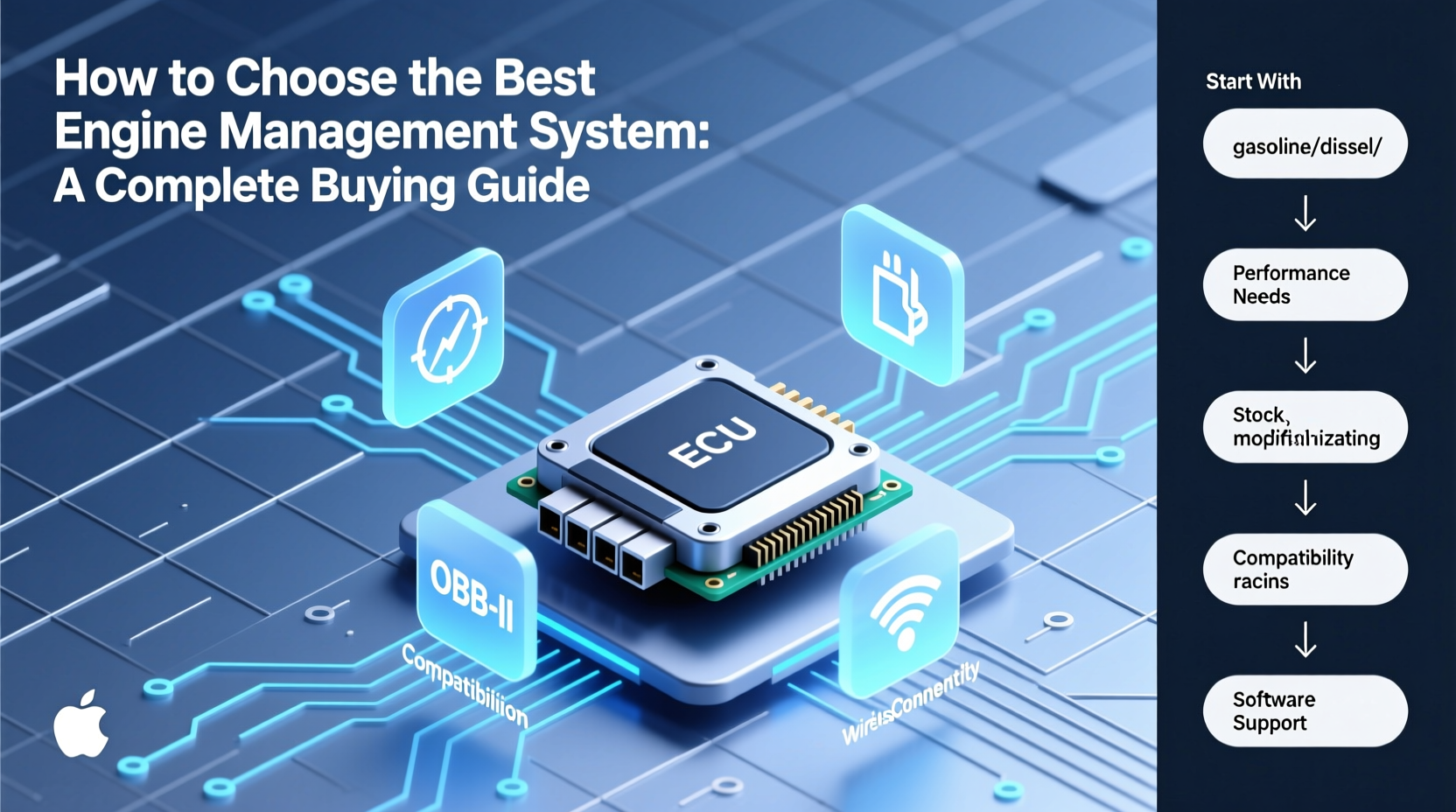
When choosing the best engine management system for your vehicle, prioritize compatibility with your engine type, required tuning flexibility, and support for real-time data logging—critical factors that define performance gains and long-term reliability 1. For enthusiasts seeking a high-performance aftermarket solution, modular systems with wideband O2 integration and CAN bus connectivity offer superior adaptability 2. If you're asking how to choose an engine management system that balances cost and capability, consider standalone units over OEM replacements unless full factory integration is essential.
About Engine Management Systems
An engine management system (EMS) is an electronic control unit (ECU) responsible for monitoring and regulating critical engine functions such as fuel injection, ignition timing, air-fuel ratio, idle speed, and emissions control 3. Modern EMS units use input from multiple sensors—including mass airflow (MAF), throttle position (TPS), crankshaft position, coolant temperature, and oxygen sensors—to dynamically adjust engine parameters under varying load and environmental conditions.
These systems are standard in all modern internal combustion engines, from passenger cars to motorcycles and light trucks. Aftermarket EMS solutions are widely used in performance tuning, motorsports, engine swaps, and custom builds where factory ECUs lack sufficient programmability or sensor support 4.
Why Engine Management Systems Are Gaining Popularity
The demand for advanced engine management systems has grown significantly due to rising interest in vehicle customization, forced induction upgrades (turbocharging and supercharging), and electric hybrid conversions 5. Enthusiasts and tuners increasingly seek precise control over engine behavior beyond what stock ECUs allow.
Additionally, improvements in embedded computing power and software interfaces have made standalone EMS platforms more accessible. Systems now offer touch-based dash displays, smartphone app integration, cloud-based firmware updates, and plug-and-play harnesses—lowering entry barriers for non-professionals 6.
Another driver is the proliferation of engine swap projects, especially involving older vehicles retrofitted with modern powertrains. In these cases, OEM ECUs may not be compatible, making programmable standalone systems necessary.
Types and Variants of Engine Management Systems
Understanding the different types of EMS available helps narrow choices based on application and technical expertise.
1. OEM Factory ECUs
Original Equipment Manufacturer (OEM) ECUs come pre-installed in vehicles and are calibrated for stock configurations. They’re reliable but limited in tuning range.
- Pros: Fully integrated, emission-compliant, no wiring modifications needed.
- Cons: Limited tuning headroom; difficult to reprogram without specialized tools.
2. Piggyback Systems
Piggyback controllers sit between the factory ECU and engine sensors, modifying signals to alter fuel and timing maps 7.
- Pros: Cost-effective; retains factory diagnostics and driveability features.
- Cons: Less precise than full standalone systems; potential signal interference issues.
3. Standalone Engine Management Systems
These replace the factory ECU entirely and provide complete control over engine operation. Popular among performance builders.
- Pros: Full tunability; supports nitrous, boost control, variable cam timing, and multi-fuel setups.
- Cons: Requires extensive wiring knowledge; higher cost; may require calibration services.
4. Plug-and-Play (PnP) Standalones
A subset of standalone systems designed with pre-wired harnesses matching specific vehicle models.
- Pros: Easier installation; reduces wiring errors; ideal for DIYers.
- Cons: Model-specific; less flexible for major modifications.
Key Features and Specifications to Evaluate
Selecting the right system requires evaluating several technical criteria:
- Number of Fuel & Ignition Channels: Determines support for sequential injection and individual coil control. High-performance engines benefit from full sequential capability 8.
- Input/Output (I/O) Expandability: Look for systems supporting additional sensors (e.g., knock, flex-fuel, wideband O2) and outputs (boost solenoids, nitrous stages).
- Data Logging Capability: Real-time logging of RPM, AFR, MAP, TPS, etc., is crucial for tuning and diagnostics.
- Software Interface: User-friendly software with map visualization, auto-tuning wizards, and simulation modes improves accessibility 9.
- Communication Protocols: CAN bus support enables integration with digital dashes, traction control modules, and transmission controllers.
- Firmware Updates: Regular updates improve stability and add features—check manufacturer update frequency.
Pros and Cons of Upgrading Your Engine Management System
When It Makes Sense:
- You’ve modified the engine (intake, exhaust, turbo, cams).
- You need precise air-fuel ratio control for safety and efficiency.
- You're performing an engine swap incompatible with the original ECU.
- You want datalogging and remote tuning capabilities.
When It Might Not Be Worth It:
- Your vehicle remains completely stock.
- You lack access to tuning expertise or diagnostic tools.
- Budget constraints make professional calibration unaffordable.
- Emissions compliance is mandatory in your region—aftermarket tuning may void certification.
How to Choose an Engine Management System: Step-by-Step Guide
- Define Your Use Case: Is it daily driving, track use, drag racing, or off-road? Performance goals dictate system complexity.
- Confirm Engine Compatibility: Ensure the EMS supports your engine’s configuration (e.g., 4-, 6-, or 8-cylinder; naturally aspirated or forced induction).
- Check Sensor Requirements: Verify if your setup needs additional sensors (e.g., dual widebands, cam sync) and whether the EMS can process them.
- Assess Installation Complexity: If inexperienced, opt for plug-and-play systems rather than universal kits requiring custom harness fabrication.
- Review Tuning Support: Some brands offer pre-loaded base maps or partner with tuning shops—this reduces setup time 10.
- Evaluate Software Learning Curve: Test demo versions if available. Complex software may require weeks to master.
- Verify Legal Compliance: In regions like California (CARB) or the EU, certain aftermarket ECUs may not meet emissions standards—always check certification status.
- Look for Warranty & Support: Reputable manufacturers offer multi-year warranties and responsive technical assistance.
Red Flags to Avoid:
- No official documentation or outdated user manuals.
- Lack of community forums or third-party tuning support.
- Unrealistic performance claims without independent verification.
- Inability to provide firmware changelogs or update history.
Price & Market Insights
Engine management systems vary widely in price based on functionality and brand reputation:
- $150–$400: Basic piggyback modules or entry-level PnP standalones (e.g., for small-displacement engines).
- $400–$900: Mid-tier standalone systems (e.g., Haltech Express, MoTeC M1 Lite) with good I/O and tuning flexibility.
- $900–$2,500+: High-end systems (e.g., Motec M150, Link G4X) used in professional motorsports with extensive expandability 11.
Consider total cost of ownership: budget for tuning services ($300–$1,000), additional sensors, and installation tools. A cheaper ECU with poor software may end up costing more in labor and troubleshooting.
| Model | Type | Price Range | Best For | Notable Feature |
|---|---|---|---|---|
| Link G4X Fury | Standalone | $1,200 | Track & Rally Builds | Integrated 16-channel data logging |
| Holley Terminator X Max | PnP Standalone | $899 | V8 Engine Swaps | Touchscreen display included |
| Motec M1 LITE | Standalone | $1,800 | Professional Racing | CAN bus expansion ready |
| AEM Infinity 506 | Universal Standalone | $950 | 4-Cylinder Turbo Applications | User-friendly software interface |
Customer Feedback Synthesis
Analysis of user reviews across automotive forums and retail sites reveals consistent themes:
Common Praises:
- "The Holley Terminator X transformed my classic truck into a reliable performer with modern drivability." 12
- "Link G4X offers rock-solid reliability during endurance events."
- "AEM Infinity software makes tuning intuitive even for beginners."
Recurring Complaints:
- "Installation took longer than expected due to unclear wiring diagrams."
- "Customer support was slow to respond when I encountered boot-up errors."
- "Base maps were inaccurate, requiring expensive dyno tuning."
Overall satisfaction correlates strongly with availability of accurate documentation and local tuning resources.
Sourcing & Supplier Tips
Purchase from authorized dealers or directly from manufacturers to ensure warranty validity and genuine firmware. Avoid third-party marketplaces unless seller reputation is verified.
For bulk purchases (e.g., race teams or shops), inquire about distributor programs offering discounted pricing, training, or loaner units. Always request a return policy that allows testing before final calibration.
Before accepting delivery, inspect packaging for tampering and verify model number against order confirmation. Test basic functionality (display, button response, USB connection) upon receipt.
Maintenance, Safety & Legal Considerations
Regularly back up ECU maps before making changes. Use surge protectors during tuning sessions to prevent voltage spikes from damaging the unit 13.
Ensure proper grounding and waterproofing, especially in exposed locations. Overheating is a common cause of EMS failure—install in shaded, ventilated areas.
Legally, altering the ECU may violate emissions regulations in regulated markets. In the U.S., CARB-certified ECUs carry an Executive Order (EO) number; using non-compliant units on public roads can lead to fines or failed inspections 14. Similarly, EU countries enforce strict type-approval rules under Euro 6 standards.
Conclusion
Choosing the right engine management system hinges on matching technical capabilities to your specific project goals. Whether you're building a street-driven V8 or a turbocharged race car, prioritize compatibility, ease of tuning, and long-term support. Standalone systems offer maximum control but require greater expertise, while plug-and-play variants lower the barrier for DIY installations. Always validate regional compliance requirements and factor in the full cost of implementation—including tuning and sensors—when comparing options. By following a structured evaluation process, you can select a reliable, future-proof EMS that delivers optimal performance and durability.
FAQs
What is the difference between an ECU and an engine management system?
An ECU (Engine Control Unit) is the hardware component, while "engine management system" refers to the entire ecosystem—including ECU, sensors, wiring harness, and tuning software—that manages engine operations.
Can I install an engine management system myself?
Yes, if you have intermediate electrical skills and follow detailed instructions. Plug-and-play systems are safer for beginners; universal kits often require professional help.
Do engine management systems improve fuel efficiency?
They can, especially when fine-tuning air-fuel ratios and ignition timing. However, gains depend on calibration quality and driving habits.
How often should I update my EMS firmware?
Check for updates annually or before major modifications. Manufacturers release patches to fix bugs and enhance compatibility.
Are aftermarket engine management systems legal for road use?
Some are, provided they carry emissions certifications (like CARB EO). Always verify legality in your jurisdiction before installing on a street-legal vehicle.





 浙公网安备
33010002000092号
浙公网安备
33010002000092号 浙B2-20120091-4