
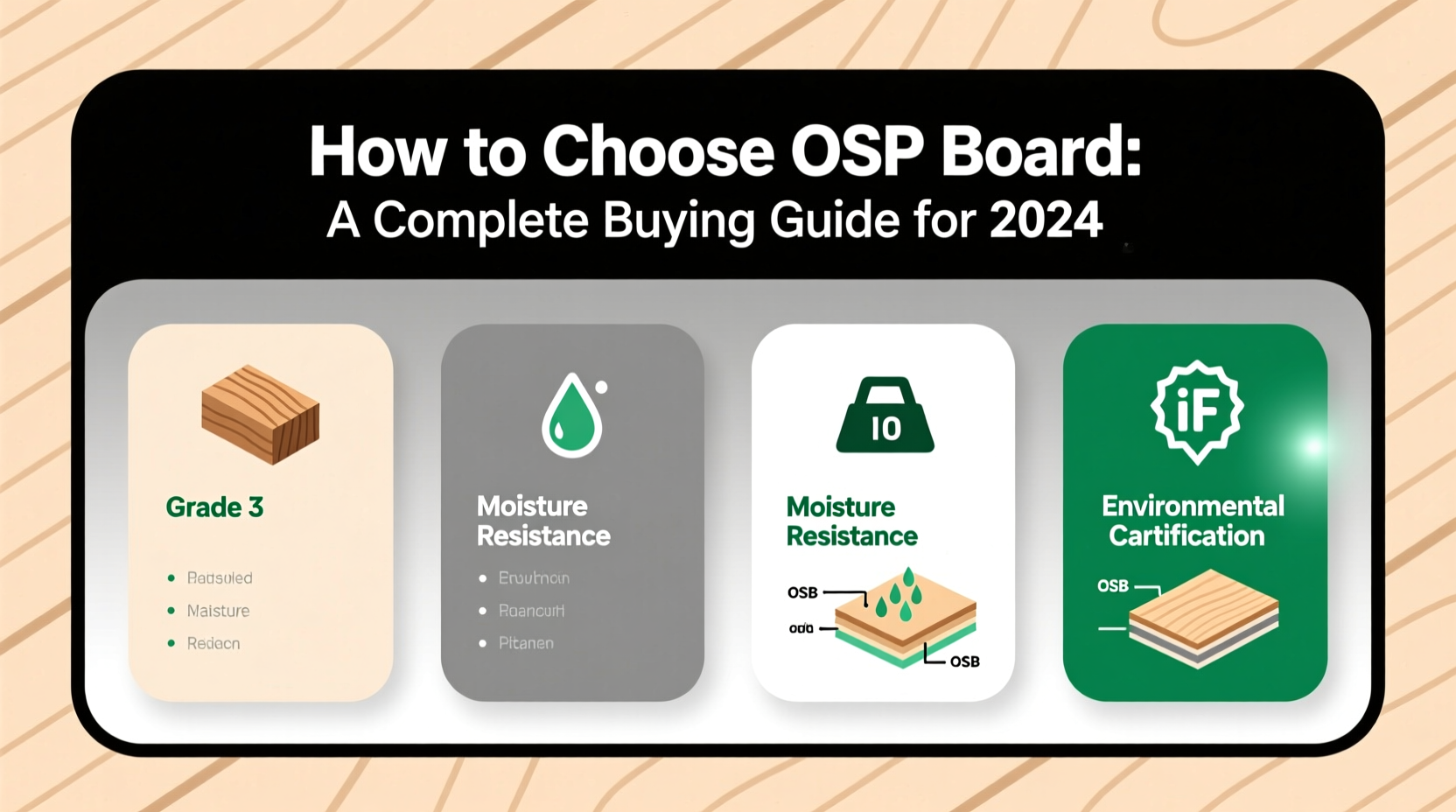
When deciding how to choose OSB board for structural sheathing or subflooring, prioritize panels with APA certification, a minimum thickness of 7/16 inch for walls, and exposure-rated glue (E0 or E1 formaldehyde emission) if used indoors 1. Look for consistent core density, smooth surface finish, and edge alignment to avoid installation issues. For most residential construction projects, choosing 4x8-foot OSB3 boards with stamped performance ratings ensures compliance with building codes and long-term durability 2.
About OSB Board
Oriented Strand Board (OSB) is an engineered wood product made by compressing layers of wood strands with adhesives under heat and pressure. The strands are oriented in specific directions—typically lengthwise on the outer layers and cross-oriented in the core—to enhance strength and stiffness 3. Unlike plywood, which uses veneers, OSB utilizes small-diameter logs and fast-growing species like aspen or southern pine, making it a cost-effective and sustainable alternative.
Common applications include roof decking, wall sheathing, and subflooring in residential and light commercial construction. It's also used in manufactured homes, shipping containers, and temporary structures due to its dimensional stability and resistance to warping. Because OSB can be produced in large, uniform sheets without natural defects, it offers predictable performance across batches—a key advantage over solid wood panels.
Why OSB Board Is Gaining Popularity
OSB has steadily displaced plywood in many markets due to its lower cost, typically 10–20% less per sheet 4. This price advantage stems from efficient raw material utilization and scalable manufacturing processes. Additionally, advancements in adhesive technology have improved moisture resistance and reduced off-gassing, addressing earlier concerns about indoor air quality and swelling.
Builders appreciate OSB’s uniformity—there are no knots or voids that could compromise structural integrity. Its ability to span joists and studs reliably makes it ideal for floor and roof systems. Moreover, sustainability trends favor OSB because it uses smaller trees from managed forests, reducing pressure on old-growth timber resources 5.
Types and Variants
OSB comes in several grades and performance categories, each suited to different applications:
- OSB1: General-purpose interior use, such as furniture or non-structural components. Not suitable for wet conditions 6.
- OSB2: Load-bearing panels for dry environments, commonly used for flooring in dry rooms.
- OSB3: Most widely used in North America; designed for load-bearing applications in humid conditions (e.g., roofs, walls). Offers better moisture resistance than OSB2 7.
- OSB4: High-strength variant used in heavy-load or extreme weather applications, such as industrial flooring or exterior cladding in harsh climates.
Thicknesses range from 3/8 inch to 1 inch, with 7/16 inch and 15/32 inch being standard for sheathing. Tongue-and-groove (T&G) edges are available for subfloors to prevent unevenness between panels. Some manufacturers offer pre-primed or coated OSB for improved moisture resistance or easier finishing.
Key Features and Specifications to Evaluate
To make an informed decision when selecting OSB board, consider these critical factors:
- APA Certification: Look for the APA (American Plywood Association) stamp or equivalent third-party verification. This ensures the panel meets ASTM D3808 or CSA 0437 standards for structural performance 8.
- Exposure Rating: Panels labeled “Exposure 1” withstand short-term moisture during construction but are not intended for permanent outdoor use without protection. True exterior-grade OSB must be covered with weather-resistant barriers.
- Formaldehyde Emissions: For indoor applications, choose low-emission products meeting CARB Phase 2 or EPA TSCA Title VI requirements to ensure healthy indoor air quality 9.
- Panel Size & Edge Type: Standard 4x8 feet is most common. T&G edges reduce deflection in floors. Square-edged panels work well for walls and roofs where support framing is closer.
- Weight & Handling: Thicker OSB (e.g., 1-inch) can weigh over 100 lbs per sheet. Consider ease of transport and labor needs on-site.
Pros and Cons
Advantages:
- Lower cost compared to plywood
- Consistent quality and structural performance
- Better shear strength in certain orientations
- Sustainable sourcing from fast-growing trees
- Resistant to delamination when properly installed
Disadvantages:
- Swells at edges when exposed to prolonged moisture unless sealed
- Heavier than plywood of comparable thickness
- Not ideal for direct exterior exposure without cladding
- Limited sandability or refinishing capability
- Can emit odors during installation, especially in poorly ventilated spaces
OSB is best suited for structural applications protected from weather. Avoid using standard OSB in areas prone to frequent water contact, such as bathroom subfloors or exterior soffits, unless specifically rated and treated.
How to Choose OSB Board
Follow this step-by-step guide to select the right OSB for your project:
- Determine Application: Is it for roofing, wall sheathing, or subflooring? Use OSB3 or higher for load-bearing and humid zones.
- Check Local Building Codes: Verify required thickness, span ratings, and fire classifications. Some jurisdictions mandate specific certifications.
- Select Thickness: 7/16 inch suffices for roof sheathing with close rafter spacing; 15/32 to 19/32 inch is recommended for subfloors 10.
- Inspect Panel Edges: Ensure tight bonding and minimal gaps between strands. Poor edge integrity indicates lower-quality pressing.
- Avoid Panels with Visible Defects: Warping, discoloration, or loose strands suggest improper curing or storage damage.
- Verify Manufacturer Warranty: Reputable brands offer limited warranties against manufacturing defects.
- Ask About Return Policies: If unused panels remain, confirm whether returns are accepted, especially for bulk orders.
Red flags include missing performance stamps, inconsistent thickness across a stack, or strong chemical smells indicating uncured resins.
Price & Market Insights
As of 2024, typical retail prices for 4x8-foot OSB panels range from $12 to $25 per sheet, depending on thickness and grade 11. OSB3 in 15/32-inch thickness averages around $18 per sheet. Bulk purchases (e.g., full skid of 40–50 sheets) often reduce unit cost by 10–15%.
Premium options with enhanced moisture barriers or factory-applied coatings may cost 20–30% more but can save labor and materials in high-humidity regions. While budget brands exist, they may lack rigorous quality control—verify test reports before substituting for code-compliant installations.
Top-Seller & Competitive Analysis
| Brand | Type | Thickness | Key Feature | Approx. Price (per sheet) |
|---|---|---|---|---|
| Knauf Egger | OSB3 | 15/32" | Low formaldehyde, T&G edge | $21 |
| Norbord ContiBoard | OSB3 | 7/16" | High shear strength, APA rated | $16 |
| LP Legacy Premium | OSB3 | 19/32" | Water-resistant coating | $24 |
| Georgia-Pacific | OSB3 | 15/32" | Widespread availability | $18 |
Each brand balances cost, availability, and added features. LP’s coated OSB reduces on-site sealing needs, while Norbord offers competitive pricing for standard builds.
Customer Feedback Synthesis
Buyer reviews frequently highlight OSB’s affordability and ease of cutting with standard tools. Professionals praise its flatness and consistency across large surfaces. However, recurring complaints include edge swelling when stored outdoors before installation and difficulty fastening near panel ends without pre-drilling.
Some DIYers report unpleasant odors during installation, particularly in enclosed spaces—this usually dissipates within days. A few users note that cheaper brands show visible resin pockets or soft spots, emphasizing the importance of inspecting sample panels before large purchases.
Sourcing & Supplier Tips
Purchase OSB from reputable lumberyards, home improvement chains (e.g., Home Depot, Lowe’s), or specialty building suppliers. For large projects, consider direct delivery from distributors to avoid handling multiple heavy sheets.
If buying in bulk, request a mill certificate or batch test report to verify compliance. Store panels flat on raised platforms, protected from rain and ground moisture. Inspect upon delivery—most suppliers allow claims for damaged goods within 48 hours.
For international buyers or custom specifications, verify compatibility with local building standards, as OSB grading systems vary by country (e.g., EN 300 in Europe vs. PS1-09 in the U.S.).
Maintenance, Safety & Legal Considerations
Once installed and covered, OSB requires no maintenance. However, during handling, wear gloves and dust masks—cutting generates fine particles and resin dust. Ensure adequate ventilation when working indoors.
Never leave OSB exposed to weather for extended periods; even Exposure 1 panels can degrade after repeated wetting. Use housewrap or roofing underlayment promptly after installation.
Compliance with local building codes is essential. Always follow manufacturer-recommended fastener schedules and edge support requirements to maintain structural integrity and warranty coverage.
Conclusion
Selecting the right OSB board involves balancing performance, cost, and application needs. For most structural uses, OSB3 panels with APA certification, appropriate thickness, and low-emission adhesives provide reliable, code-compliant solutions. Prioritize panels with clean edges, uniform density, and recognized testing marks. Avoid uncertified or damaged boards, especially in critical load-bearing roles. By evaluating your project’s environmental conditions and structural demands, you can confidently choose an OSB product that delivers durability and value.
FAQs
- Can OSB be used outdoors? Only temporarily during construction. Finished OSB must be protected with siding, roofing, or paint to prevent moisture absorption.
- How do I seal OSB edges? Apply exterior-grade acrylic caulk or specialized edge sealant to cut edges, especially in high-moisture areas like bathrooms or near foundations.
- Is OSB stronger than plywood? In shear strength, OSB often performs better, but plywood handles repeated wetting and drying cycles more effectively.
- What size screws should I use for OSB subfloor? Use #8 or #10 structural screws, 1.5 inches long for 15/32-inch OSB, spaced per code requirements (typically 6 inches on edges, 12 inches in field).
- Does OSB emit harmful fumes? Modern OSB meets strict emissions standards. Ventilate well during installation, especially in enclosed spaces, to minimize temporary odor exposure.




 浙公网安备
33010002000092号
 浙B2-20120091-4