
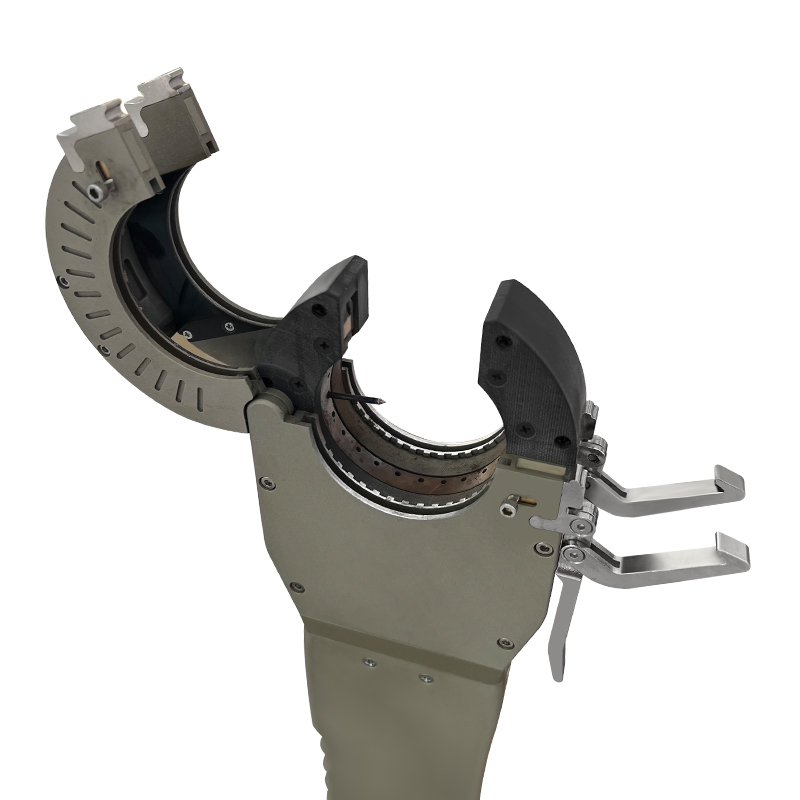
When choosing the best orbital welding machine for precision pipe joining in industries like aerospace, pharmaceuticals, or power generation, prioritize systems offering consistent weld quality, automation compatibility, and support for your specific tube or pipe materials and diameters 1. For those searching 'how to choose orbital welding machine' with a focus on repeatability and code compliance, automated DC TIG orbital units are typically the optimal choice, especially for stainless steel, titanium, or high-purity applications requiring minimal human intervention 2.
About Orbital Welding Machine
An orbital welding machine automates the arc welding process around a stationary workpiece, typically pipes or tubes, using a rotating welding head that travels circumferentially to create a uniform, high-integrity joint 3. Unlike manual GTAW (TIG) welding, which depends heavily on operator skill, orbital systems deliver precise control over parameters such as travel speed, current modulation, shielding gas flow, and arc length.
These machines are commonly used in mission-critical environments where weld integrity is non-negotiable. Applications include semiconductor manufacturing, biopharmaceutical piping, nuclear facilities, offshore oil & gas platforms, and boiler systems in power plants 4. The primary benefit lies in eliminating variability—each weld follows a pre-programmed sequence, ensuring consistency across hundreds or thousands of joints.
Why Orbital Welding Machine Is Gaining Popularity
The demand for orbital welding machines has grown significantly due to increasing requirements for higher quality standards, regulatory compliance, and labor efficiency. In sectors governed by ASME B31.3, ASTM, or FDA regulations, documentation and traceability of each weld are mandatory—features built into most modern orbital systems 5.
Additionally, skilled welder shortages have driven companies to adopt automation solutions that reduce dependency on manual expertise. Orbital welding allows less experienced technicians to produce certified welds under supervised programming, improving throughput while maintaining safety and quality 6. Furthermore, digital integration enables remote monitoring, data logging, and real-time adjustments via software interfaces, making these systems ideal for smart manufacturing environments.
Types and Variants
Orbital welding machines come in several configurations based on application scale, mobility, and level of automation:
1. Portable Orbital Welding Systems
- Pros: Lightweight, field-deployable, suitable for on-site pipeline repairs or construction projects.
- Cons: Limited power output; may require external gas and cooling units.
- Ideal for: Field service teams working in oil & gas, HVAC retrofits, or remote installations 7.
2. Benchtop / Stationary Units
- Pros: Higher precision, integrated cooling and gas supply, better suited for repetitive production tasks.
- Cons: Not mobile; requires dedicated workspace and stable environmental conditions.
- Ideal for: Manufacturing cleanrooms, laboratory equipment fabrication, or small-batch medical device tubing 8.
3. Fully Automated Production Lines
- Pros: High throughput, integrates with robotics and conveyor systems, supports full data tracking.
- Cons: Expensive setup; requires engineering support and significant floor space.
- Ideal for: Automotive exhaust systems, heat exchangers, or large-scale industrial component assembly.
4. Micro-Orbital Systems
- Pros: Designed for ultra-thin walls and small diameters (as low as 3 mm), often used in semiconductor or life sciences.
- Cons: Very sensitive to fit-up; limited material thickness range.
- Ideal for: High-purity fluid delivery systems where particulate generation must be minimized.
Key Features and Specifications to Evaluate
When evaluating what to look for in an orbital welding machine, consider the following technical and operational criteria:
- Welding Process: Most use DC TIG (GTAW); ensure polarity control and pulse capability match your base metal 9.
- Diameter Range: Confirm compatibility with your smallest and largest tube OD (e.g., 6–150 mm).
- Wall Thickness Support: Thin-wall (<1 mm) vs. thick-wall (>5 mm) affects required amperage and head design.
- Material Compatibility: Stainless steel, carbon steel, aluminum, titanium, and nickel alloys each require different settings and gas mixes.
- Shielding Gas Control: Dual-gas purging (primary and secondary) is essential for oxidation-sensitive materials.
- Programmability: Look for systems with intuitive UIs, password protection, and memory for multiple weld schedules.
- Data Logging & Traceability: Required for audits—verify if the system exports timestamps, parameter deviations, and weld IDs.
- Cooling System: Air-cooled heads suffice for short cycles; water-cooled necessary for long-duration welds 10.
- Portability & Power Requirements: Check voltage needs (110V vs. 220V) and whether battery operation is supported.
Pros and Cons
Advantages
- Exceptional weld consistency and reduced defect rates.
- Lower long-term labor costs despite higher initial investment.
- Improved safety through reduced operator exposure to arc radiation.
- Compliance-ready with digital records for QA/QC processes.
- Suitable for confined spaces or hazardous environments using remote operation.
Disadvantages
- High upfront cost compared to manual welding setups.
- Requires skilled setup and programming—not truly 'plug-and-play'.
- Sensitive to poor joint preparation (gap, misalignment, contamination).
- Limited flexibility for non-circular or irregular geometries.
- Dependence on proprietary consumables and service networks.
How to Choose an Orbital Welding Machine
Follow this step-by-step guide to make an informed decision tailored to your operational needs:
- Define Your Application: Are you welding hygienic tubing in a pharma plant or heavy-walled pipes in a refinery? This determines size, power, and certification needs.
- Assess Tube/Pipe Dimensions: Measure typical outer diameter and wall thickness. Ensure the weld head can clamp securely without slippage.
- Select the Right Type: Opt for portable units if working offsite; benchtop for controlled environments.
- Evaluate Control System: Touchscreen interfaces with preset libraries simplify training and reduce errors.
- Check Integration Needs: If connecting to SCADA or MES systems, verify communication protocols (Ethernet/IP, Modbus, etc.).
- Review Service and Support: Look for local technicians, warranty length (typically 1–3 years), and availability of loaner units during repairs.
- Avoid Red Flags: Be cautious of vendors who don’t provide sample weld demonstrations, lack documentation, or offer unusually low prices indicating outdated technology.
Price & Market Insights
Pricing varies widely based on capability and brand. As of 2024:
- Entry-level portable kits: $8,000–$15,000 11.
- Midsized benchtop systems: $18,000–$35,000.
- High-end automated cells: $50,000–$150,000+.
Value isn't just about price—it includes durability, ease of calibration, software updates, and consumable costs. Some manufacturers charge premium prices for proprietary torches or firmware licenses. Consider total cost of ownership over five years, including maintenance contracts (~$1,500–$3,000/year) and replacement parts.
Top-Seller & Competitive Analysis
Several brands dominate the orbital welding market, each with distinct strengths:
| Model | Weld Diameter Range | Key Feature | Approx. Price |
|---|---|---|---|
| Lincoln Electric UltraCore 350 | 6–127 mm | Integrated water cooler, cloud-based data sync | $27,000 |
| ORBITARC OA-V8 | 10–200 mm | Modular design, open API for factory integration | $22,500 |
| Rolls-Royce RoboArc 6000 | 5–150 mm | AI-assisted parameter optimization | $48,000 |
| ESAB Miniflex ORB | 3–76 mm | Compact, ideal for micro-tubing | $14,800 |
Note: Always verify specifications directly with the manufacturer, as performance claims may vary by region or configuration.
Customer Feedback Synthesis
Analysis of user reviews and industry forums reveals common themes:
- Positive Feedback: Users consistently praise weld consistency, reduction in rework, and ease of meeting inspection standards. Many highlight time savings in repetitive jobs and improved workplace safety 12.
- Common Complaints: Difficulties include steep learning curves for programming, slow customer support response times, and high costs of replacement weld heads or seals. Some users report compatibility issues when mixing components from different product lines.
Sourcing & Supplier Tips
When sourcing orbital welding equipment:
- Purchase from authorized distributors to ensure warranty validity.
- For bulk purchases (3+ units), negotiate bundled training and service agreements.
- If considering used or refurbished systems, insist on recent calibration certificates and functional testing videos.
- Verify return policies—some suppliers allow 30-day trials with deposit.
- Ask for references from similar industries to assess real-world reliability.
Maintenance, Safety & Legal Considerations
Regular maintenance is critical: inspect O-rings, drive gears, and electrode condition monthly. Follow manufacturer-recommended recalibration intervals (usually every 6–12 months) 13.
Safety practices include proper grounding, ventilation for ozone removal, and PPE even though operators are distanced from the arc. Legally, orbital welds in pressure systems must comply with jurisdiction-specific codes (e.g., ASME Section IX, PED in Europe). Always document weld procedures (WPS) and qualify them per applicable standards.
Conclusion
Selecting the right orbital welding machine involves balancing precision needs, budget constraints, and long-term serviceability. For buyers asking 'what to look for in orbital welding machine', focus on compatibility with your materials and dimensions, robust data management, and vendor support quality. While the initial investment is substantial, the return comes in reduced scrap, faster inspections, and superior process control—especially vital in regulated industries. Prioritize systems proven in your sector and test them with actual production samples before committing.
FAQs
Q: Can orbital welding machines work on carbon steel?
A: Yes, but ensure the system supports appropriate current settings and shielding gas (typically argon or argon/helium mix) for carbon steel to prevent porosity 14.
Q: How long does it take to learn orbital welding operation?
A: Basic operation can be learned in 2–5 days, but mastering programming and troubleshooting may take weeks of hands-on experience.
Q: Do orbital welders require special power sources?
A: Most require stable 110V or 220V input; three-phase power is needed only for large industrial models.
Q: Are used orbital welding systems worth buying?
A: Potentially, but only if they come with full service history, updated firmware, and pass a performance test under load.
Q: Can orbital welding replace all manual TIG welding?
A: No—orbital excels at circumferential pipe welds but cannot handle complex joints, repairs, or non-rotational geometries.




 浙公网安备
33010002000092号
 浙B2-20120091-4